
Leaks
How to spot leaks early, from toilets and appliances to the hot water cylinder, and what to do if one happens.
If you have a leak right now
- Turn off your water at the stopcock. It's behind the ceiling access panel just outside your front door, which opens with a square tee key (cheap from any DIY shop, and worth keeping in the flat).
- If water is near anything electrical, switch off the power at the consumer unit (fuse box) in your airing cupboard, if you can reach it safely. If the leak is from the hot water cylinder, switch off the immersion heater too.
- Let your neighbours below know, so they can protect their belongings.
- Report it to Ringley on 0330 174 7747 (Monday to Friday) or joe.bartlett@ringley.co.uk. Out of hours, call 0207 428 2056.
Why leaks matter here
The 60 flats at Sovereign Quay share one communal water supply, paid for through the service charge, so water that leaks away in any one flat is paid for by every flat. (The commercial units each have their own separate supply.) Our communal water use has more than doubled recently, so we're asking every household to check three things: toilets, washing machines and dishwashers, and the hot water cylinder.
Leaks also travel. Water from one flat can damage the flats below, and under the lease each owner keeps their own flat's pipes, cylinder and appliances in good repair. Where an unmaintained installation causes damage, the costs can be recharged to the owner responsible.
Toilets: the biggest water waster
A toilet cistern that keeps refilling, because water is trickling past a worn valve or seal into the bowl, is one of the biggest wasters of water there is: fixing one can save 200 to 400 litres a day. It's silent and easy to miss, so please check yours.
Washing machines and dishwashers: the most disruptive leaks
When a washing machine or dishwasher leaks, the water goes straight through the floor to the flat below, so these leaks cause the most damage and disruption to neighbours. Most start with a perished hose or a failed seal.
- Check the hoses and their connections behind the machine now and then for bulges, cracks or damp, and replace them at the first sign of wear.
- Where you can, run them while you're home and awake, so if something fails you can stop it quickly. If you run them overnight to make the most of a cheaper off-peak or smart tariff, a water leak alarm on the floor behind the machine is an inexpensive safeguard: it sounds whatever the source of the leak.
- Know the isolation valve: there's usually one on the pipe behind each machine. A quarter turn shuts off that machine's water without turning off the whole flat; turn it off when you go away.
Check your hot water cylinder
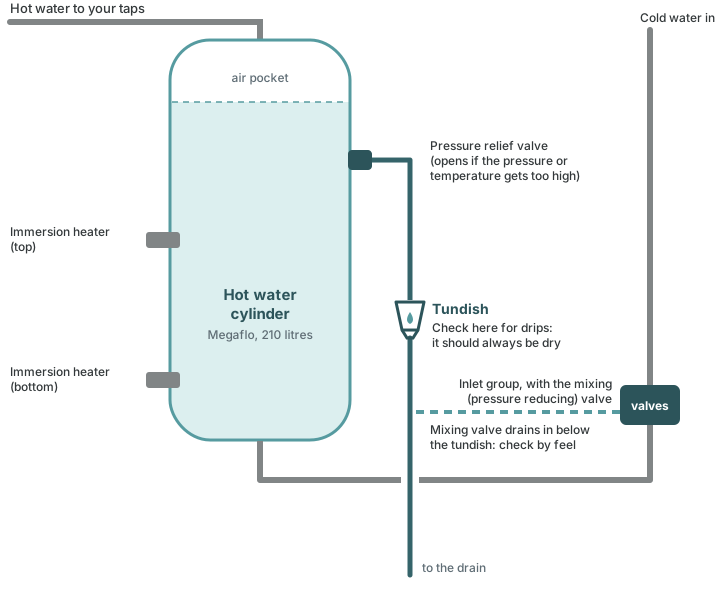
Every flat has a Megaflo hot water cylinder, most of them original to the building from around 2004. Each holds 210 litres and is heated by electric immersion heaters. Because it runs at mains pressure, it has a pressure relief valve that releases water if the pressure or temperature gets too high, and that water drains away through the tundish: a small fitting with open sides on the pipe below the cylinder, designed so you can see if water is passing through it.
Check once a month, in two steps. First, look into the tundish: it should be completely dry. For a quick test, hold a folded square of dry kitchen paper in the opening for a few minutes, ideally while the water is heating; if it comes out damp, water is escaping. Take the paper out afterwards, and never leave anything in the tundish or block it: it's a safety outlet.
Second, feel the pipe below the tundish. The mixing (pressure reducing) valve drains into this pipe below the tundish, so a fault there never shows on the paper. If the pipe feels cold when no water is being used, and you can hear water running, water is running away through it.
What you might find
Drips at the tundish while the water heats
The pressure relief valve opening as the water expands, usually because the cylinder's internal air pocket has run low; the water may feel warm. Book a service to have the air pocket recharged.
A steady trickle at the tundish, even when not heating
The pressure relief valve no longer sealing. Book an engineer soon: this kind of leak runs day and night.
Hot water at the tundish, or a hot pipe
The pressure relief valve has opened because the water is overheating, often because a thermostat has failed. Switch off the immersion heater now and call an engineer urgently.
A dry tundish, but a cold pipe below it
Water running away through the mixing (pressure reducing) valve, which drains in below the tundish where the paper can't catch it. You may also hear water running constantly. Book an engineer.
Other causes worth checking
Baths and showers
Cracked or missing sealant lets water seep into the floor and through to the flat below. If the seal around your bath or shower tray looks tired, replace it.
Taps
A dripping tap is easy to ignore, but it adds up on a shared supply. Fix drips promptly.
Download the guide
Everything on this page is also in our two-page leaks guide (PDF), handy to print or keep by the cylinder. If you rent, your landlord should make sure your cylinder is serviced; please tell them, and Ringley, about any leak.